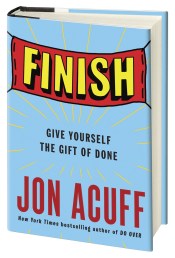
Finish: The Importance of Finishing Strong


Finish 3d cover

If you’re like me it’s easy to start goals but difficult to complete them. I just read Finish by Jon Acuff and it put me in a focused mindset.

According to a study conducted by the University of Scranton, 92% of resolutions fail.

That’s a staggering number considering how important goals are to companies. 

You actually have a greater shot of getting into Julliard in New York City to be a ballerina than hitting your next sales goal.

Or your next budget reduction. 

Or your next widget production.

At every element of your work, goals matter. What if we could do some simple things to improve how often we finished what we started? What if we could complete the incomplete projects and tasks? What if we could get more done in a world of bottomless opportunities and endless distractions?

How does Acuff know? Research, research and more research!

Jon suspected goal-completion was not luck or genetics. And he partnered with a university researcher to test what makes a person a CONSISTENT FINISHER instead of just a CHRONIC STARTER. The research team analyzed 900 people over a lengthy process. These are not just theories – these are principles built on analytics and research. 

The good news is, you can learn to finish. It’s not a natural talent some people have and others do not. It can be taught. Ever have an employee, team member or department almost finish something? It’s time to learn what it really takes! Starting is fun, but the future belongs to finishers.

Without giving away too much of the book, here are two stats you can incorporate into your strategy to help you finish your goals.

2 Surprising Stats About Goals & Resolutions:

  1. People who work on small goals are 63% more successful.
  2. People who have fun are 46% more successful.

Did You Give It Your Best Shot?

So what happens when you gave your goals your best shot but nothing much has changed? I personally have been going through a period of stagnation and have learned how to deal with it from a healthy perspective.

Last year I did everything possible to advance The Connect with Your Calling Project. I was able to help a few people get connections to advance their careers and I’m grateful that some are making progress. With one client in particular we went through the casting process for 2 national TV shows and almost got selected both times but then towards the end we were cut. Needless to say this was an emotionally draining process and very disappointing.

We haven’t given up and decided to keep moving forward but we’ve learned some valuable lessons along the way. I’ve made a conscious decision that I’m not going to let my happiness be dependent on whether or not we achieve our goal. I’ll be thrilled to help my client get her product on national TV but the outcome is not under my control. I’ve decided to be content regardless of the outcome to maintain my peace and happiness.

Going after your dreams is a bruising process so here are a few suggestions that came from an article written by Bishop Joseph W. Walker III.

  1. Find contentment. When you know you’ve done your best and given your all, you can live with no regrets.
  2. Begin with the end in mind. Visualize where you want to be this time next year and come up with a strategy with small measurable steps.
  3. Set realistic goals. Don’t overdo it. Recognize that you are only one person and it’s better to do a few things well than do many things horribly.
  4. Be intentional about prioritizing. Failure to do so may lead to unnecessary compromises that may set you back.

Develop Consistency using the PERMA Model

There are various reasons people have trouble maintaining consistency while pursuing their goals. Speaking for myself, when I’m doing activities that are tedious and uncomfortable, it’s hard to remain consistent, even if the task is beneficial to me in the long term. The process of change is challenging, if we could reap the rewards without putting in the work, everyone would be successful at achieving their goals.

For everyone who may be struggling to keep going through a difficult process here’s some advice that may help you. The PERMA Model was developed by psychologist, Martin Seligman. PERMA stands for (P) positive emotion, (E) engagement, (R) positive relationships, (M) meaning, and (A) accomplishment/achievement. So basically if you can incorporate some of these elements into what you’re doing to reach a goal, you’ll be more connected to your goal and more likely to remain consistent.

I’ll use the example from my previous post about losing weight since that’s one of the most common New Year’s resolutions. If I wanted to lose weight, I’d do a physical activity that I enjoy to generate (P-positive emotions). I like walking but in order create (E-engagement) I’d choose a scenic trail that has surroundings that interests me to look at while I’m walking. To add (R-positive relationships) I’d walk with a friend to have fun talking while we walk. I’d include (M-meaning) by entering a charity walk for a cause that I care about like breast cancer fundraising and to produce (A-accomplishment/achievement) I’d train for a challenging distance for me which would be a half- marathon.

You may not be able to add all 5 elements but the more you can incorporate these in your activities, the more fulfilling the process will be. The more (connected) emotionally invested you are to your goal, the less likely you are to quit.